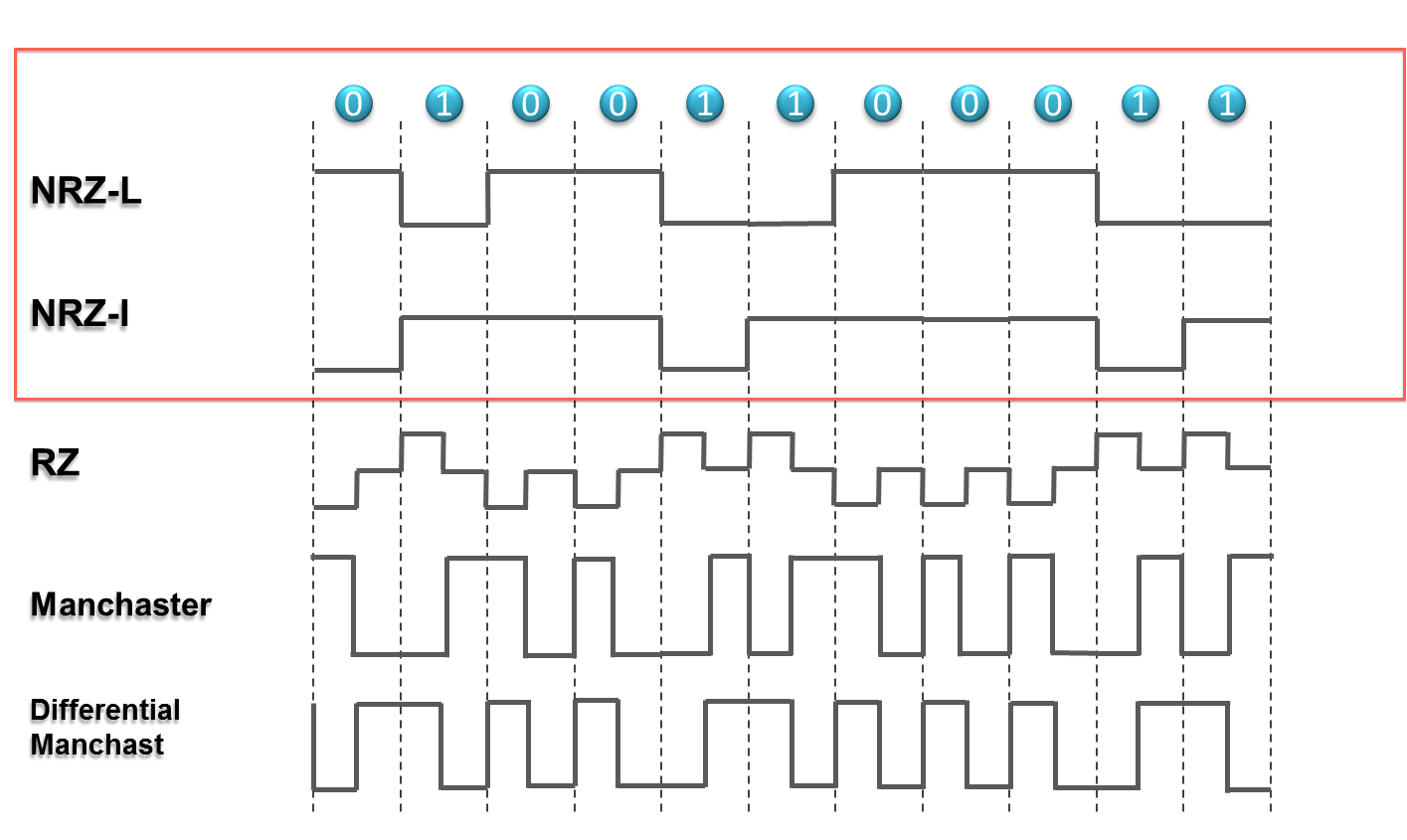
Non-Return to Zero (NRZ)
The most common, and easiest, way to transmit digital signals is to use two different
voltage levels for the two binary digits.
Codes that follow this strategy share the property that the voltage level is constant during a bit interval, there is no transition during that
interval. It is known as Non-Return to Zero (NRZ).
For example, the absence of voltage can be used to represent binary 0, with a constant positive voltage used to represent binary 1.
In NRZ a negative voltage is used to represent one binary value and a positive voltage is used to represent the other.
NRZ is given in figure.
A variation of NRZ is known as NRZ (Non return to zero, invert on ones).
The data themselves are encoded as the presence or absence of a signal transition at the beginning of the bit time.
NRZ is an example of differential encoding.
In differential encoding, the signal is decoded by comparing the polarity of adjacent signal elements.
One benefit of this scheme is that it may be more reliable to detect a transition in the presence of noise than to compare a value to a threshold.
Another benefit is that with a complex transmission layout, it is easy to lose the sense of the polarity of the signal.

 A variation of NRZ is known as NRZ (Non return to zero, invert on ones).The data themselves are encoded as the presence or absence of a signal transition at the beginning of the bit time.NRZ is an example of differential encoding.In differential encoding, the signal is decoded by comparing the polarity of adjacent signal elements.One benefit of this scheme is that it may be more reliable to detect a transition in the presence of noise than to compare a value to a threshold.Another benefit is that with a complex transmission layout, it is easy to lose the sense of the polarity of the signal.